Back
The Top 9+ Email Marketing Tools for Small Businesses


Summary
Email marketing helps small businesses connect with audiences and promote products, but choosing the right software can be challenging. A curated list of ten top email marketing tools, including Poptin, SendX, Mailchimp, and SendPulse, offers solutions tailored to diverse business needs. These platforms vary in pricing and features, ranging from lead capture pop-ups and automation to multi-channel marketing and full CRM integration.
Key takeaways
- Email marketing enables small businesses to connect with audiences, build customer relationships, and promote services effectively.
- Poptin combines smart pop-ups, embedded forms, and automated email campaigns to capture and nurture leads successfully.
- SendX runs its own proprietary sending engine, making it suitable for high-volume email campaign deliverability.
- Selecting the right email marketing tool depends entirely on specific business goals, features, and budget needs.
Email marketing is one of the most effective ways to reach your customers and grow your small business. It allows you to connect with your audience on a personal level, build relationships, and promote your products or services. With low-cost but highly effective email marketing tools, even small businesses can scale quickly and efficiently.
However, many small businesses struggle with choosing the right tool. Without the right email marketing software, even the best campaigns can fail to convert leads into sales, or worse, derail a company’s marketing efforts entirely.
But don’t worry, we’ve compiled a list of the top 10 email marketing tools for small businesses that will help you navigate this crowded market. Whether you’re just starting with email marketing or looking for more advanced features, there’s a tool here for every business.
1. Poptin – All-in-One Email Marketing Tool
Poptin is an all-in-one email marketing automation and conversion optimization platform that helps businesses capture and nurture leads. It combines smart pop-ups, embedded forms and email campaigns in one tool. Using Poptin’s drag-and-drop editor, you can design pop-ups or forms to collect subscriber emails and then follow up with targeted newsletters and automated customer journeys. In other words, Poptin lets you grow your audience, capture leads, and nurture subscriber relationships without needing a separate email provider.

The platform supports rich segmentation (by behavior, tags or custom fields) and lets you trigger welcome emails, cart-abandonment reminders, birthday offers and more, based on user actions. Poptin also includes built-in analytics so you can monitor campaign performance and ROI in real time.
Key Poptin features include:
- Pop-ups & Forms: Numerous customizable templates (lightbox, slide-in, spin-the-wheel, exit-intent, etc.) that trigger by scroll, inactivity, exit intent, gamification or scheduling. These help capture leads by offering coupons, quizzes or content upgrades when visitors try to leave or after a delay.
- Email Campaigns & Automations: A drag-and-drop email builder for one-off broadcasts (newsletters, announcements) and visual automation workflows. You can send unlimited emails on paid plans and set up multi-step sequences such as welcome series, abandoned-cart recovery, birthday and win-back campaigns.
- Segmentation & Personalisation: Tag contacts based on popup interactions or site behaviour to send them relevant emails. Poptin tracks opens, clicks, bounces, etc., enabling dynamic segments (e.g. by campaign engagement, cart status or demographics). You can insert merge tags and custom fields to personalise messages.
- Analytics & Reporting: Built-in analytics dashboards report on conversions, opens, clicks and other metrics so you can see which popups or emails are driving sign-ups and sales. Poptin’s analytics let you optimise campaigns by measuring performance across all channels.
- Integrations: Connect Poptin to e-commerce or CRM systems (Shopify, Stripe, HubSpot, etc.) to trigger pop-ups or emails from cart or lifecycle events. You can also push contacts to external tools (Mailchimp, ActiveCampaign, etc.) via integrations.
Start converting more visitors by using Poptin’s popups to grow your list, then engaging those leads with built-in email newsletters and automations. Sign up for a free Poptin account today to create your first popup and email campaign (no credit card needed).
Check out this article: Email Popups: 6 Creative Offers You Can Use To Help You Grow Your Email List
2. Google Forms – Creating Surveys For Email Subscribers
This is one of the best tools to conduct surveys with. It’s an app that’s hosted on the Google Suite, so businesses that already do plenty of work on Google Workspace will be familiar with how Forms works. While Google doesn’t offer a ton of creative elements to add to these surveys, many companies use them.
That means that the visitors to the site won’t look at surveys on these templates and feel like they’re going to be scammed. It’s one of the cheapest email marketing tools out there as well.
3. SendX: Best for High-Volume Senders and Growing Businesses
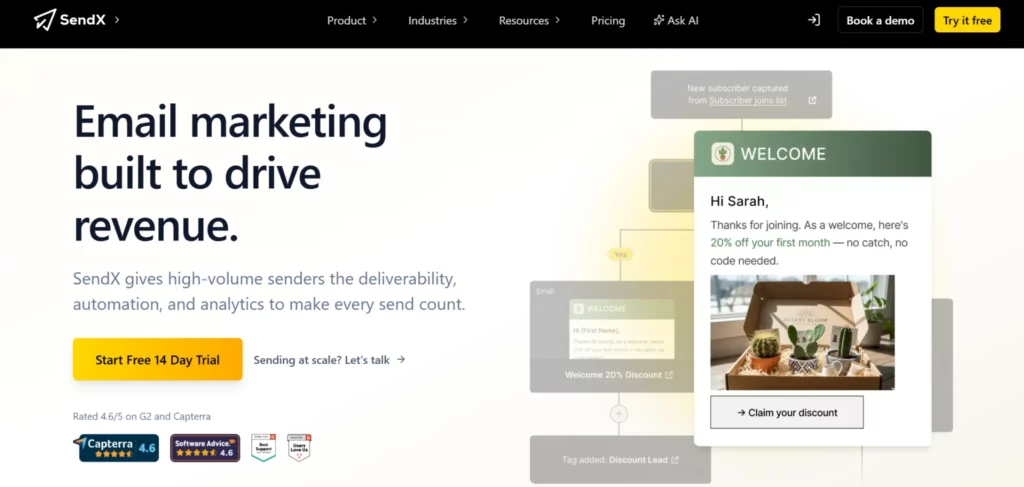
SendX is a full-stack email marketing platform built for businesses that want their emails to actually reach the inbox. SendX runs its own proprietary sending engine and deliverability infrastructure, so campaigns don’t rely on shared third-party pipes to get delivered.
This makes SendX a solid choice for growing businesses that are sending hundreds of thousands of emails a month. Whether it’s an ecommerce store running promotional campaigns, a SaaS company sending lifecycle emails, or an agency managing multiple client accounts, the platform handles deliverability end-to-end.
SendX comes with a drag-and-drop editor, 1000+ templates, and an AI SendX Editor that helps generate subject lines, body copy, and design variations quickly. The visual workflow builder supports 48+ triggers across integrations like Shopify, Stripe, WooCommerce, and HubSpot, so businesses can set up cart recovery, onboarding sequences, and post-purchase automations without much effort.
SendX charges based on subscriber count only, with unlimited emails on every plan. Annual pricing starts at $7.49/month for up to 1,000 subscribers, and there’s a 14-day free trial available with no credit card required.
4. Constant Contact – Email marketing campaigns
Constant Contact is one of the large-scale email marketing platforms on the market. It offers users the option to run surveys and different types of tests with emails within their user base. If there’s one thing it may be lacking, it could be the creative elements.
While there are many constant contact alternatives on the market, there are two main reasons, though, why it’s growing in popularity. It’s become a platform that’s always looking to provide training to its users. It also features one of the best customer service departments on the market.
It could be a good idea to still use apps like Photoshop or Canva for some of the creative elements since the platform doesn’t feature that many interesting templates. At that price range and with such a good customer service team, it’s certainly one of the larger platforms that are worth a look.
5. Amazon SES (Simple Email Service)
This is one of those email marketing tools that’s going to be a must-have for businesses that get a lot of Amazon sales. It’s a pay-as-you-go service that charges based on the volume of emails sent.
In essence, it’s the service that’s going to facilitate the emails that need to go out to clients when they buy a product on the Amazon platform. That way, it can make tracking these products easier for clients.
The downside is that it wouldn’t make much sense for a company that doesn’t sell much on Amazon to implement it. It’s also not a completely free service, as some people may have guessed. The free service lasts up to the first year of use and allows customers to receive up to 3,000 message charges free each month after they start using SES.
Regardless, it can be a great option for businesses that are run on AWS platforms.
6. SendPulse – Email Creation and Automation

SendPulse is a multi-channel marketing automation platform that offers a variety of tools. This tools help businesses of all sizes grow their audience and sales.
It is a popular choice for small businesses because it is affordable and easy to use. SendPulse also offers a variety of features that are essential for growing a business, such as email automation and segmentation.
It is easy to create and send email campaigns, import, manage and segment email lists, and create automated workflows with this platform. Any company can get started with the core features on the free plan. The free plan permits up to 15,000 emails per month.
7. Nutshell – Combine Email Marketing with Sales & CRM
Nutshell is another one of these platforms that goes beyond the email marketing features. It can be a great CRM for small businesses to work with. Primarily because it allows users to migrate or directly integrate data. From apps such as Slack or even software from the Google Suite.
The main focus of Nutshell is those integration capabilities. It does have an email marketing branch as part of the software, but it may not feature as many templates and design options as other apps that are already on the list.
8. Drip – Email engagement and marketing
Drip is an email marketing platform that offers segmentation, email creation and automation capabilities. People can design what they want to send out for the day. They can also use the platform directly to send it to the people on their list.
It’s easier to use than many other options. Companies that are looking for email marketing tools with a good design suite can benefit from Drip. It costs $39 a month to send emails to up to 2500 users.
9. Mailchimp – Email Segmentation and Marketing

Mailchimp is a long-standing email marketing platform that has become a popular choice over time. A lot of people know and trust this software because of its extensive suite of tools that make email marketing such a breeze.
It provides pre-built email templates, automation, integrations, email scheduling, a/b testing capabilities, segmentation and more recently, generative AI features.
The free version is pretty extensive, but it includes the Mailchimp branding on the emails and is limited to 1000 monthly emails sends and 1 seat.
Companies that are looking to implement their own design should switch to the basic option, which costs $13 a month.
10. Flodesk
Flodesk is a Mailchimp alternative that’s design-oriented. The interface looks more like what people would expect from Canva. Its image editor is pretty easy to use, allowing anyone with limited design experience to create decent-looking emails.
The 38-dollar-a-month version allows users to send unlimited emails, add embedded forms and create workflow automation. That’s a great deal that a small business could benefit from.
What could be holding this platform back a bit is its data collection methods. They’re not as extensive as they are in other apps.
Conclusion
The email marketing tools listed above vary in their features and pricing, offering different levels of complexity and customization. Some, like Poptin, are great for growing your email list with minimal effort, while others, like Nutshell and SendPulse, provide full CRM integration to streamline sales and marketing efforts.
For businesses that are beginning to see growth in website traffic, email marketing tools like Poptin can complement existing strategies by capturing leads effectively through popups. Popups are one of the most effective ways to generate leads, particularly from visitors who have already shown interest by browsing your site.
Ultimately, the right tool depends on your business needs and goals. By carefully considering your requirements, whether that’s list building, automation, or advanced segmentation, you can find a solution that helps you grow your email marketing campaigns successfully.
Give Poptin a try today and start generating leads for your business. Sign up for free and explore how popups can help you grow your email list.